
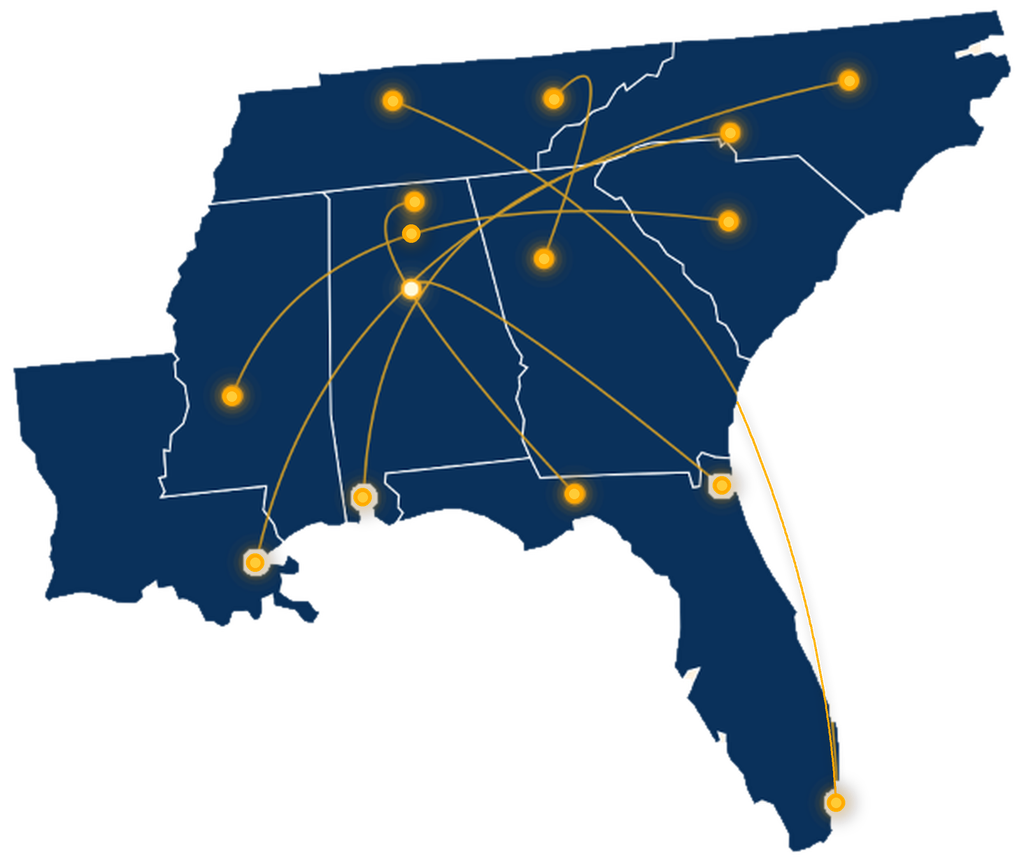
BioPharmaBrief’s Inside the Hubs: Innovation in the Southeast explores the people and partnerships moving the region’s companies forward.
The Southeast has long been home to major research universities, leading medical centers and companies serving global markets. Across the region, communities are building on that foundation to give life sciences businesses more room to grow. New manufacturing investments, specialized incubators and expanding industry partnerships are giving entrepreneurs new ways to build their companies and reach customers around the world.
The scale is already substantial. North Carolina is home to 860 life sciences companies employing 76,000 people, according to the North Carolina Biotechnology Center. Georgia’s life sciences companies employed more than 78,000 people in 2021, according to the Georgia Department of Economic Development, and Tennessee’s bioscience workforce rose 60% in four years to more than 48,000 in 2023, according to a report from BIO and TEConomy Partners. In Alabama, Lilly announced plans in December 2025 to invest more than $6 billion in a Huntsville pharmaceutical manufacturing facility, citing workforce potential and infrastructure among the factors behind its selection.
Alongside established industry, emerging hubs are making it possible for founders to build companies in the places they call home. Their progress gives investors, executives and prospective partners good reason to take a closer look.
With Inside the Hubs: Innovation in the Southeast, BioPharmaBrief will explore what makes those communities compelling, how they are developing and what more of their companies will need to succeed.
A Strong Foundation for New Companies
The Southeast’s academic institutions are among its greatest strengths in life sciences. Universities and medical centers across the region generate discoveries, train scientists and engineers, and connect research with clinical needs. UAB, Emory, Georgia Tech, Vanderbilt and the universities of North Carolina’s Research Triangle are prominent examples of a research base where academic and clinical expertise supports new ventures in the surrounding community.
That academic strength gives the region a continuing source of technologies and talent around which companies can develop. It also allows entrepreneurs to work with researchers and clinicians as they refine their products and identify where those products could make a difference.
Established industry adds commercial experience to that foundation. North Carolina’s life sciences manufacturing operations, Memphis’s medical device industry and South Carolina’s manufacturers and research laboratories bring expertise in developing, testing and producing technologies for the market.
For communities across the Southeast, the opportunity is to build more businesses around those assets. Smaller hubs have an important role in connecting local entrepreneurs with nearby academic institutions and the wider region’s industry expertise. Stronger relationships among these communities can give promising science more places to become a company, and those companies more support as they advance.
A Place to Build and Grow
For a young life sciences company, location can influence how far its funding goes. In the second quarter of 2026, Cushman & Wakefield reported average asking rents for life sciences space of approximately $39 per square foot in Raleigh-Durham and $79 in Boston. Costs vary by market and facility, but the comparison illustrates the difference location can make to a company’s budget.
Affordability also matters to the people building the business. Consumer price levels in Alabama, Tennessee and North Carolina were below the national average in 2024, according to the U.S. Bureau of Economic Analysis. Alongside quality of life, living costs can influence where founders and employees choose to establish their careers.
Incubators and accelerators can further reduce the cost and complexity of getting started. Shared laboratories give companies access to space and equipment they may be unable to afford independently. Experienced advisers work with founders to refine their plans and connect with potential customers, collaborators and investors across the Southeast and elsewhere in the industry.
In our conversations for this series, leaders emphasize getting to know each company and staying involved as its needs change. Support can continue after an accelerator ends, whether through laboratory access, a clinical introduction or help finding specialized expertise. For founders, that means having people who understand their business and remain invested in its success.
Stronger Connections, Wider Reach
Scaling these companies will require strong connections to resources within the Southeast and across the wider industry. In our interviews, access to institutional capital emerges as a persistent challenge, particularly as companies need larger investments to advance. Leaders also identify a need for shared manufacturing facilities and experienced professionals who have taken emerging businesses through that stage before.
Addressing those needs means building relationships with investors and partners whose expertise fits a company’s next stage. A founder may need financing for clinical development, a manufacturing partner or an executive who has brought a similar product to market. Those relationships allow companies to keep building in the Southeast while drawing on resources wherever they are available.
The region brings considerable value to those partnerships. Its academic research, clinical expertise and established industry offer real opportunities for investors and businesses looking for new technologies and collaborators. Making those opportunities visible is essential if more companies are to attract the support they need.
Throughout Inside the Hubs, we will meet the people building those connections and explore what their communities have to offer. In the weeks ahead, we will hear from Georgia Life Sciences in Atlanta, HudsonAlpha Institute for Biotechnology in Huntsville and the Wiregrass, Hatch in Fairhope and Cumberland Emerging Technologies in Nashville. Their experiences will give us a clear view of where the region is making progress, what still needs work and how new partners can participate in its growth.
The series leads into the BioPharmaBrief Southeast Spotlight, a virtual showcase for the region’s life sciences companies during J.P. Morgan Healthcare Conference week, January 11 to 13, 2027.
The Southeast has much to offer. This series is an invitation to get to know it.